

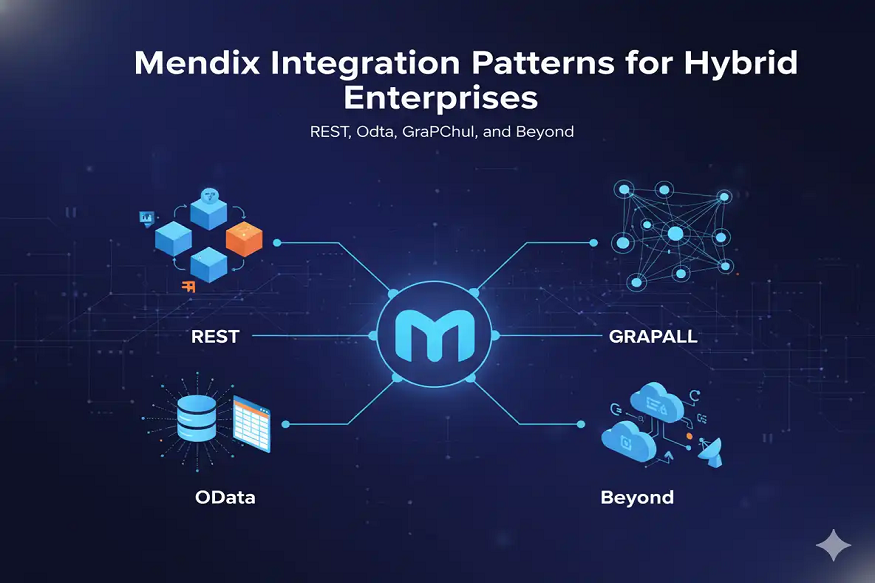
A Comprehensive Guide by We LowCode
Modern enterprises no longer rely on a single monolithic system to run their operations. Instead,
they employ a hybrid landscape of SaaS applications, legacy platforms, on-premises
databases, cloud microservices, IoT devices, and event-streaming pipelines. The
challenge is not just building digital experiences—it’s ensuring that data flows seamlessly
across all these systems.
This is where Mendix, as a leading low-code platform, excels. Its integration capabilities allow
organizations to orchestrate complex multi-system workflows, extend legacy applications,
modernize digital experiences, and connect data sources using standardized and flexible
patterns.
In this detailed guide, we explore REST, OData, GraphQL, message queues, event-driven
architectures, and other Mendix integration strategies that hybrid enterprises can
adopt—supported by Mendix Consulting experts and Mendix Development Services teams like
We LowCode.
- The Hybrid Enterprise Challenge
Today’s enterprises operate across environments such as:
- On-premise ERP systems (SAP ECC, Oracle EBS, etc.)
- Cloud SaaS platforms (Salesforce, Workday, ServiceNow)
- In-house microservices hosted on Kubernetes or VMs
- Public cloud services (AWS, Azure, GCP)
- Data warehouses, streaming platforms, and analytics engines
- Legacy mainframe or custom-built applications
Integrating these systems demands:
- Interoperability across protocols and formats
- Real-time data exchange where necessary
- Security and compliance across internal and external systems
- Scalability to handle increased load
- Consistency across distributed systems
- Flexibility to adapt to changing business landscapes
Mendix enables all these through a wide set of predefined integration connectors, runtime
capabilities, event listeners, message queues, and extension modules.
- Core Mendix Integration Patterns
Mendix provides a robust toolbox for building integrations that fall into five broad patterns:
- Synchronous API-based integrations (REST, SOAP, OData, GraphQL)
- Asynchronous messaging via queues and event buses
- Data federation and virtualization
- Microservice and domain-driven integrations
- Custom connector-based integrations
Let’s dive deeper into each—highlighting how Mendix Consulting and Mendix Development
Services teams apply them in real enterprise scenarios.
- REST API Integrations: The Backbone
of Modern Connectivity
REST is the most commonly used method for connecting Mendix applications with external
systems. Mendix provides out-of-the-box REST consumption and exposure tools.
3.1 REST Consumption
You can easily consume REST APIs using:
- Mendix Call REST Service activity
- Custom request headers and authentication
- JSON-to-entity mapping
- Automatic import/export mapping generation
Typical REST use cases:
- Integrating with Salesforce, Workday, or ServiceNow
- Pulling location or mapping data from Google APIs
- Connecting to microservices hosted on AWS or Azure
- Retrieving product or order data from ERP systems
Why REST fits hybrid enterprises:
It’s lightweight, standard, scalable, and widely supported.
3.2 REST Exposure
Mendix can also act as a REST API provider.
You can expose:
- Endpoints for CRUD operations
- Custom domain logic
- Secure API gateways with OAuth2
This lets Mendix serve as a:
- Data provider
- Workflow orchestrator
- Integration middleware layer
With strong governance, versioning, and documentation features, many enterprises rely on
Mendix to publish business logic to external platforms.
-
OData Integrations: Ideal for Enterprise
Data Models
OData (Open Data Protocol) is especially useful for integrating Mendix apps with platforms like
SAP, Microsoft Dynamics, and analytics tools.
4.1 When to Use OData
Use OData when:
- The consuming system expects a standardized, queryable data feed
- You need live data exposure without building custom endpoints
- Integrating Mendix with SAP S/4HANA or SAP ECC
- Connecting to Microsoft Power BI, Excel, or Dynamics
4.2 Mendix OData Capabilities
Mendix enables:
- OData service exposure
- Entity-level permissions
- Reusable data sets for BI and analytics tools
- Metadata-based, discoverable data structures
This pattern fits teams focused on data transparency and reporting, while reducing API
development time.
- GraphQL Integrations: Flexible and
Developer-Friendly
GraphQL has gained traction for modern microservices, headless CMS platforms, and
composable commerce solutions.
5.1 Why GraphQL?
GraphQL allows clients to request exactly the data needed, reducing:
- Over-fetching
- Under-fetching
- Excessive API round-trips
5.2 GraphQL in Mendix
While Mendix doesn’t natively support GraphQL out of the box like REST/OData, teams typically
implement GraphQL through:
- Java actions calling GraphQL endpoints
- Custom connectors
- Community GraphQL modules
5.3 When to Choose GraphQL
GraphQL shines when:
- Building front-end apps that need granular data
- Integrating with headless platforms like Contentful, Shopify, Strapi
- Designing microservice orchestration layers
- Creating modern digital experiences with complex UIs
For hybrid enterprises moving toward composability, GraphQL is becoming an essential
integration pattern.
- Event-Driven Integrations: The Future of
Hybrid Enterprises
Reactive, asynchronous systems are key for modern enterprises where real-time events
matter—such as IoT, logistics, manufacturing, and financial systems.
6.1 Event-Driven Architecture (EDA) Overview
EDA allows applications to respond to events like:
- Order placed
- Payment received
- Sensor reading updated
- Shipment dispatched
- Data change in legacy systems
This leads to decoupled, scalable, and high-performance integration patterns.
6.2 Mendix Event-Driven Capabilities
Mendix supports EDA through:
- Message Queues (RabbitMQ, Azure Service Bus, AWS SQS)
- Event Streams (Kafka, Kinesis)
- Mendix Message Broker
- Webhooks
- Custom event listeners
- Publish/Subscribe models
6.3 When to Use Event-Driven Patterns
Choose EDA when:
- Data consistency is eventual
- Zero-downtime processing is needed
- High throughput systems must communicate
- You need asynchronous communication between apps
- Integrating with legacy systems that emit events
This pattern is highly recommended for IoT, manufacturing, supply chain, and fintech
solutions.
- Multi-System Orchestration: Mendix as
an Integration Hub
Modern enterprises need orchestration that handles:
- Multiple external services
- Composite transactions
- Conditional logic flows
- Workflow-based operations
- Error recovery and retry patterns
Mendix microflows and nanoflows offer a visual and powerful orchestration layer.
7.1 Orchestration Use Cases
- Syncing customer data across CRM, ERP, and DXP
- Multi-step order fulfillment workflows
- Complex approval processes across departments
- Data synchronization between on-prem and cloud systems
7.2 Mendix as a “Digital Orchestration Layer”
Thanks to its model-driven approach, Mendix integrates front-end, middle-layer logic, and
back-end services seamlessly.
This is why many enterprises turn to Mendix Consulting partners like We LowCode to build
orchestration-heavy solutions that replace costly middleware.
- Mendix Connectors and Marketplace
Modules
Instead of building custom integrations from scratch, Mendix offers a constantly growing
ecosystem of ready-made connectors:
- SAP Connector
- Salesforce Connector
- Microsoft Dataverse Connector
- AWS Toolkit
- Azure Integration Suite
- Kafka, RabbitMQ, and Service Bus modules
- Payment gateways (Stripe, Adyen)
- Identity providers (Azure AD, Keycloak, Okta)
These accelerate delivery and reduce development overhead—key benefits emphasized by
leading Mendix Development Services teams.
- Integration Best Practices for Hybrid
Enterprises
To build secure, scalable, and maintainable integrations, enterprises should follow these
principles:
9.1 Design for loose coupling
Use asynchronous messaging whenever appropriate to avoid tight dependencies.
9.2 Use API gateways for security
Implement:
- OAuth2
- JWT tokens
- IP whitelisting
- Rate limiting
- Gateway-level monitoring
9.3 Centralize logging and monitoring
Essential for:
- Audit trails
- API usage insights
- Error resolution
- Performance monitoring
9.4 Prefer standard protocols
REST, OData, GraphQL, and MQ protocols reduce custom code and future-proof your
integration landscape.
9.5 Build reusable integration components
Modular connectors reduce maintenance costs across multiple Mendix apps.
9.6 Use domain-driven design (DDD) for microservices
Mendix is highly compatible with DDD patterns—especially when orchestrating domain events.
9.7 Embrace event streaming for real-time use cases
Kafka and event hubs offer unmatched scalability for:
- IoT
- Telemetry
- Real-time analytics
- Supply chain visibility
- How We LowCode Delivers
Enterprise-Grade Mendix Integrations
As specialists in Mendix Consulting and Mendix Development Services, We LowCode helps
enterprises implement integration patterns that align with business goals and IT strategy.
Our Integration Capabilities Include:
- API Strategy & Architecture
- Designing REST/OData/GraphQL strategies
- API versioning & lifecycle management
- Secure API gateway configuration
- Multi-System Orchestration
- SAP + Salesforce + custom apps
- ERP + DXP + CRM synchronization
- Workflow-driven orchestration layers
- Event-Driven Solutions
- Kafka/Kinesis/SQS integration
- IoT and streaming event processing
- Asynchronous microservice communication
- Legacy Modernization
- Wrapping legacy systems with Mendix APIs
- Data migration & federation
- Building modern digital frontends
- Connector Development
- Custom integrations for niche systems
- Marketplace-ready connector packages
- End-to-End Delivery
- Strategy → Architecture → Development → Testing → Scale
We enable enterprises to transform integration challenges into strategic advantages.
Conclusion: Mendix Is the Integration
Powerhouse Hybrid Enterprises Need
Hybrid enterprises need fast, secure, and flexible integration approaches that connect every
part of the business. Mendix provides the most comprehensive toolset for building:
- REST-based service integrations
- OData-driven data exposure
- GraphQL-powered experiences
- Event-driven architectures
- Multi-system orchestration layers
With the support of expert partners like We LowCode, organizations can accelerate innovation,
modernize legacy systems, and ensure seamless connectivity across the entire enterprise
ecosystem.
If you’d like me to craft a structured blog outline, a PDF version, or a shorter LinkedIn-ready
version—just let me know!
